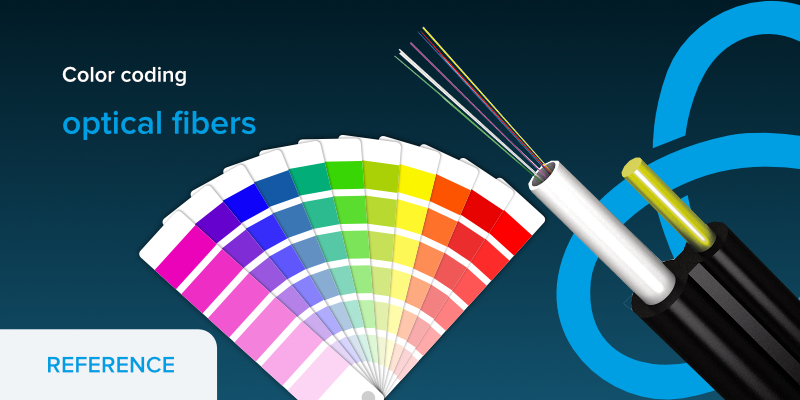
For easier identification of fibers within an optical cable and for greater convenience during installation, the following fiber identification scheme based on protective coating colors is used.
Contents:
1. LT (Loose Tube) Optical Cable
In modular construction cables (Loose Tube, LT), fiber color coding complies with the TIA/EIA-598 standard. For this purpose, 12 colors are used, as shown in Table 1. The color coding of buffer tubes also complies with this standard for cable capacities up to 144 fibers (12 buffer tubes with 12 fibers each).
Table 1. Color Coding of Optical Fibers and First-Layer Buffer Tubes
| No. | 1 | 2 | 3 | 4 | 5 | 6 |
| Color | Blue | Orange | Green | Brown | Gray | White |
| No. | 7 | 8 | 9 | 10 | 11 | 12 |
| Color | Red | Black | Yellow | Violet | Pink | Aqua |
For higher fiber counts, the buffer tubes are arranged in two layers. In this case, the first layer retains the standard identification, while the second layer uses a color key. This consists of a pair of red and green buffer tubes from which the numbering of the remaining uncolored tubes can be determined (Table 2).
Table 2. Color Coding of Second-Layer Buffer Tubes
| No. | 1 | 2 | 3 | 4 | 5 |
| Color | Red | Green | Natural | Natural | Natural |
| No. | 6 | 7 | 8 | 9 | 10 |
| Color | Natural | Natural | Natural | Natural | Natural |
| No. | 11 | 12 | 13 | 14 | 15 |
| Color | Natural | Natural | Natural | Natural | Natural |
2. UT (Uni Tube) Optical Cable
In central tube cables (Uni Tube, UT), up to 24 fibers can be accommodated. Fiber color coding for cables containing up to 12 fibers also complies with the TIA/EIA-598 standard. For fiber counts above 12, fibers numbered 13–24 use the same colors with additional identification rings, as shown in Table 3. An exception is fiber No. 20, which uses a natural color.
Table 3. Color Coding of Optical Fibers in Central Tube Cables
* where “R” denotes identification rings placed at 10 cm intervals along the fiber.
3. MT, MU Optical Cable
In cables with loose fibers and micromodules (MT, MU), color coding also complies with the TIA/EIA-598 standard. For cable capacities up to 12 fibers, the primary colors are used. For higher capacities, the same colors are used with additional identification marks (one, two, or three), as shown in Table 4.
Table 4. Color Coding of Optical Fibers in Loose Fiber Cables
* where “R” denotes rectangular identification marks placed at 7 cm intervals along the fiber.
4. FTTH Optical Cable
In single-fiber and low-fiber-count cables such as FTTH, PS, and MT-03, which are mainly used for subscriber drop connections, fiber color coding is defined by the cable Technical Specification and may not necessarily comply with the TIA/EIA-598 standard.
Table 5. Color Coding of Optical Fibers in FTTH Cables
| Single-Fiber Cable | ||||
| No. | 1 | |||
| Color | Red | |||
| Two-Fiber Cable | ||||
| No. | 1 | 2 | ||
| Color | Blue | Orange | ||
| Four-Fiber Cable | ||||
| No. | 1 | 2 | 3 | 4 |
| Color | Blue | Orange | Green | Brown |
5. PS, PS-2, MT-03 Optical Cable
Table 6. Color Coding of Optical Fibers in PS, PS-2, and MT-03 Cables
| Cable | PS | PS-02 | MT-03 | |||
| Single-Fiber Cable | ||||||
| No. | 1 | 1 | 1 | |||
| Color | White | Blue | White | |||
| Two-Fiber Cable | ||||||
| No. | 1 | 2 | 1 | 2 | 1 | 2 |
| Color | White | Blue | Blue | White | White | Blue |
6. OPGW and Other Optical Cables
For special optical cable designs developed on request (OPGW and others), fiber color coding is defined by the cable Technical Specification. In most cases, however, it complies with the TIA/EIA-598 standard or uses standard colors with additional identification marks.
Help required?
Leave us a note and we will contact you as soon as possible!